

Moonlit Melancholia
Rennala as a Shakespearean Tragic Heroine

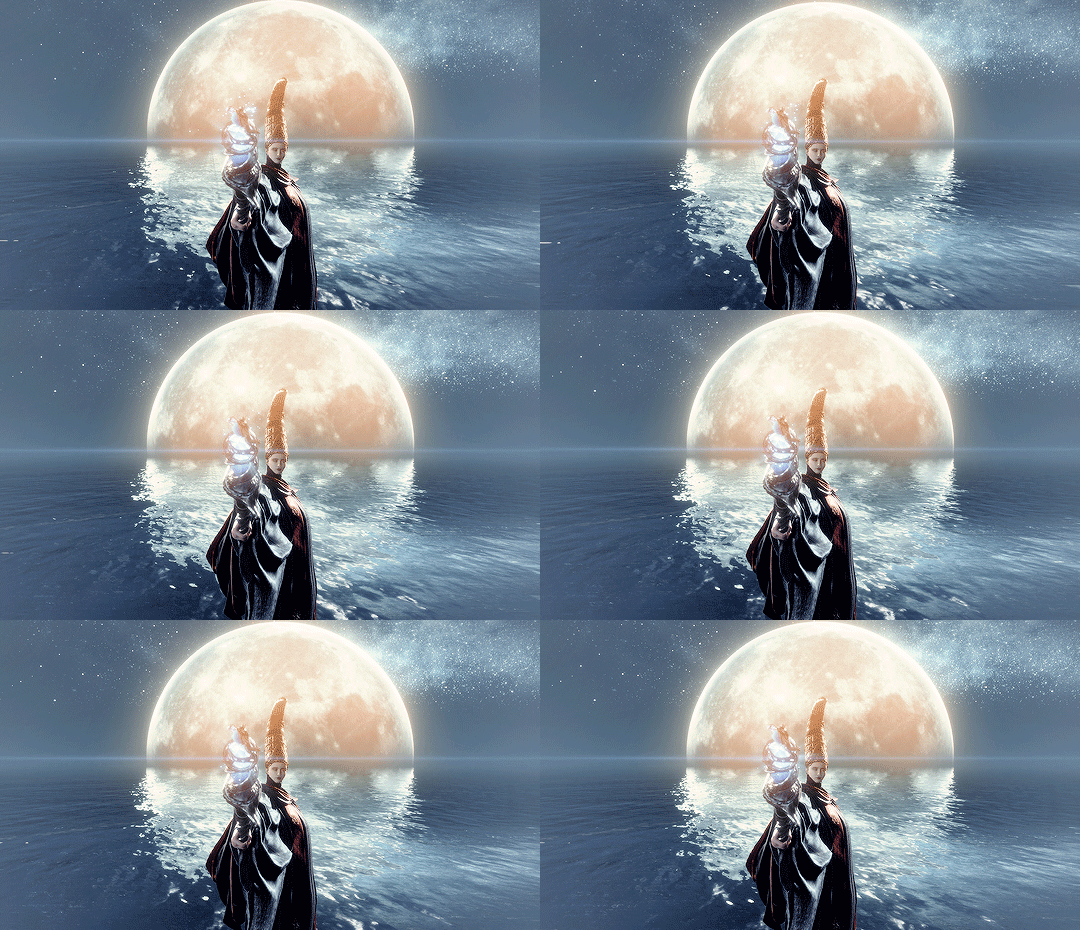
Elden Ring is no stranger to the wild, torrential moors of Gothicism. From the architecture in Raya Lucaria, to themes surrounding trauma and the paranormal, Fromsoft has used themes of classic Gothic novels ever since the very first Dark Souls game. Their narratives are steeped in literary inspiration, and there is a reason my account is so very focused on interpreting and picking apart these themes to the best of my ability. Though I do focus primarily on themes of Gothicism and Feminism, I do think these games interpret and adapt aspects from other literature beyond the Gothicism of the 18th, 19th and 20th centuries. Indeed, as the Gothic is inspired by antiquity dating all the way back to the Hellenistic era, and most notably that of Jacobean poets and playwrights.
The women of William Shakespeare have been analysed to within an inch of their lives. The famous playwright and poet is one of, if not the, most studied figures in literature. With aspects of the supernatural running riot through his tragedies, it is no wonder then that plenty of fantastical pieces of media use his themes and tropes in their narratives. This, as I will argue here, includes the 2022 masterpiece that is Elden Ring.
With its already scholarly way of depicting lore and history, Elden Ring — and souls in general — is a wonderful example of how media beyond literature can adapt and mimic that kind of storytelling and research. As I have said in previous articles, Souls is a realistic depiction of archaeology and anthropology in a fictional world. We go into these games relying in primary sources through item descriptions, dialogue, and (most importantly) the environment which we piece together ourselves. So, I also think it innately adapts such writers as Shakespeare who became the standard for both symbolic interpretation, and literary research.
But, what I want to focus on most ardently in this essay, is the way Elden Ring adapts the Shakespearean tragic heroine, specifically through our dear Rennala, and the majesty of the night she conjureth.
I do perceive here a divided duty. (Othello, 1.3)
Milly Barranger writes in THE CANKERED ROSE: A CONSIDERATION OF THE JACOBEAN TRAGIC HEROINE:
“The folk tradition in English drama nurtures the romantic heroine with her beauty, chastity, obedience, and femininity. The revenge tradition in Renaissance drama fosters the Italianate heroine characterized by superlative physical beauty, stoicism in adversity, and by adherence to appetite and will as opposed to reason” (178)
Rennala’s history opens up questions about her relation to this archetype — which does she align with most? Certainly the latter, for her subservience and weakness did not appear until she experienced the tragedy which felled her to what we discover in-game. Before the madwoman locked in the library, Rennala was a formidable foe and one of the greatest sorcerers The Lands Between had ever seen. The matriarch of House Caria, she led the Academy of Raya Lucaria with quiet proficiency and defended her Liurnia of the Lakes from aureate threat.
It is important to note here the way in which Rennala is depicted in portraits, effigies and descriptions that allude to her past. Her strength, her femininity, her regale nature. Her portraits in the Academy are humble yet elegant, she stands proud and powerful, stoic as a true leader should. It supplies connotations of anything but weakness, even the colour palette is pure majesty; a queenly majesty, strong and unmovable. This is further emphasised in her boss fight wherein Ranni, her daughter, casts an illusion that takes us to a moonlit lake wherein we fight a shadow of Rennala when she was in her prime. She stands straight, casting unending sorceries, summoning those oathsworn; those who chose to lend their power for the sake of defending their queen. Rennala is the figure of feminine strength… but this, as we know, is not to last.
Barranger explains that:
“The tragic heroine embodies the principles of human frailty. She is the weaker sex. An inferior creature formed from the bone of Adam’s rib - she is treated as the generous creation of God, given for companionship to His ultimate creation, man. She is, therefore, subject to the demands of a larger order in a world in which she has no legitimate, primary function in directing the conduct of human affairs. In effect, Elizabethan woman is a secondary creature. Her felicity is dependent upon the grace of God and the goodness of man.” (179)
Elden Ring subverts these expectations. In traditional literature, my focus here being early-age Gothicism such as the works of Ann Radcliffe and Horace Walpole, women were ardently the inferior sex, weak and helpless in the face of their male adversaries. With Souls taking from a lot of Gothic tropes, it is interesting to see how they circumvent these tropes yet still maintain themes of gender and femininity in a Gothic-esque manner. Elden Ring, of course, does not shy away from powerful women — one of the hardest bosses From has ever made is, indeed, a woman. The hardest boss (in my humble, skill issue’d opinion) they have ever made is a very feminine presenting Miquella. But in the context of Rennala specifically, I wonder if From commented on this Gothic and literary tradition (which thankfully has settled down in the grand compendium of contemporary Gothicism) in her deterioration.
Shakespearean tragic heroines is a very specific archetype found… obviously… most ardently in Shakespeare’s tragedies. They are characterised as the mirror of their tragic hero — the protagonist — who befalls a deterioration as a result of his tragic flaw. Whether that be hubris, greed, ambition, etc, the hero will always befall a fate of suffering that usually ends in death and anguish. The tragic heroine, in turn, experiences a similar downfall that is woven between the hero’s narrative, but is never the focal point of the play.
Perhaps the most memorable example of this is Lady Macbeth whose fate is kept very purposefully off stage, and whose name is never revealed as she puppets her husband. She is a woman with ambition, her flaw, who turns mad by the end out of sheer guilt for what she orchestrated.
“Look like th’ innocent flower, / But be the serpent under ‘t.” (1.5)
She, most notably, puppeteers Macbeth after she has begged supernatural powers to “unsex” her. This, of course, explains that she wishes to free herself from her innate “femininity”, often interpreted that she wishes to become, then, more masculine, but I do not agree. She makes no mention of her desire to become more masculine, simply to rid herself of what she believes is feeble femininity, that which makes her emotional and empathetic. She begs dark spirits for this gift, but of course this comes to bite her back when she eventually endures the guilt of her ambition. Notably, as I say, she ends up killing herself after a brief bout of madness, but this is off stage and Macbeth cares not; despite how prominent her part was in making him King.
I relate this to our dear Rennala whose infatuation became her eventual downfall.
Enduring the throes of war, yet defending her territory from the formidable Leyndell army, Rennala became enamoured by the auburn-haired Radagon who proposed marriage in order to illicit peace betwixt the two duelling regions. This was not wholly a political marriage, that which conjoins rival kingdoms, but one borne of genuine love. Often, Radagon is deemed the callous half-villain of Elden Ring’s tale. To many, he is merely an avaricious man with cosmic complexities relating to gender theory (and the alchemical regis blah blah blah Radagon-Marika can be interpreted as an arcane example of gender fluidity so shurrup), he is cruel, but I think he did truly love her. It is that love, though, that emphasises the tragedy of their eventual downfall. The more love, joy, contentment that is present in the narrative, the bigger potential for hate, melancholy and tragedy. If Radagon did not love Rennala, she would not have suffered such a monumental break in her psyche. There was love there, but aureate temptation sadly lured the Red Wolf from his den.
Rennala and Radagon produced three blaze-headed children during their commitment; Rykard, Radahn, and Lunar Princess Ranni. It is the latter, she who too worked to master moonlit sorceries, who became Rennala’s protector in her weakness. Likely, Ranni’s burning hair did little but ignite in turn reveries of her father’s betrayal each time she glanced at a mirror. I cannot see Ranni thinking much of her father but pure vitriol. Despite her absence from her mother’s chambers, Ranni’s connection to her is likely strong. But her mother is yet another sacrifice she had to make. The Lunar Princess hexed the library Rennala was imprisoned within, willingly no doubt, to protect her from foes who should disturb her slumber. But alas, I am getting ahead of myself.
It is after years of bliss that Radagon began to grow distant. This likely erupted a series of violent doubts that cascaded within the Queen’s mind. Despite all the love they shared, it is unfortunate that the full moon cannot give Radagon what he greedily wishes to covet. Instead, upon the banishment of Godfrey, The First Elden Lord, he caught the eye of the elusive yet seraphic Queen Marika. The duality here is staggering — blinding gold verses deep, soothing night. Radagon did not marry Marika out of love, he married her out of duty born of fate. When Radagon left his wife, Rennala grew manic. She lost her mind, and this show of mental irresolution thus planted a seed of insurrection in her Carian devotees. She no longer cared for the school, and obsession befell her. The Raya Lucarians, those who did not seek the full moon but who instead were tempted by the allure of the stars and glintstone, locked Rennala within the library.
Upon his leave, Radagon endowed her with the Great Rune of the Unborn, and the egg she covets and obsesses over. This is a nice bit of feminine imagery — the egg representing a kind of womb as she wishes to have a child, to give life back to her dissenting Empyrean daughter who chose to sever her fate in death.
This is the state we find her in: broken, insane, a lack of wit for someone once admired upon comprehension for her intellect. This insanity is what links her to the tragic heroines of Shakespeare. Either through love or ambition, these women all tend to endure a kind of madness that impedes upon their femininity. When the king goes mad, he becomes dangerous and unpredictable — a formidable foe yet easy to fell. When his nameless wife endures the same, she has not the power of he, and so befalls a pathetic fate befitting her supposed weakness of sex. Lady Macbeth’s off-stage death, that which is spoken of once wherein Macbeth says:
“She should have died hereafter.” (5.5)
Meaning, she would have died regardless so what point is there to mourn her now? The woman is abandoned, both by the characters in the play but also by the audience. The Playwright does not intend for us to think about her any longer. She is dead, her work and impact has been fulfilled, she now will rot, unattended, left alone forevermore. I think this is interesting in Rennala’s case as it feels significant. She is our respec lady, and the player certainly has more of a focus on her than any other character, but her actual existence is entirely without meaning. She sits alone in her library, the doors are open but she will not leave — for she has a child to grow. We return when we need to change our stats, but otherwise all other quests that require this room are separate from her significance. Boc will pass away unfulfilled if we oblige his shallow wish, and not his heartfelt desire, to the obliviousness of the Queen. Even Sellen, now a Graven Mass, will make no impact on Rennala.
Just like Lady Macbeth, this woman — once the towering, formidable Queen of Caria — is given over to a death-like fate. She might as well be dead for her child will surely never grow and her mind will never recover. Abandoned by her husband, her children… and now we, who meekly disturbs her, only to return her, unaffected, to her place in the library.
This is interesting narratively, for it is not often we make zero difference to the lives of Fromsoft’s bosses. Mostly, they are killed by us, but Rennala seems to be a rare exception. We do not change her at all. We cannot change her, whether that is from the strength of her witlessness, or simply that she does not wish to change. If that is the case, then the Lands Between has certainly not stripped her of her strength. The woman who fought off the Leyndell army led by Godfrey, who communed with the full moon, who ruled over Liurnia for however many decades — a broken heart was enough to destroy her… or did it?
Now I am not saying this is canon, and I do understand this is a bit of a tangent, but just bear with me. As I say, there are no other bosses, to my knowledge, that are totally and wholly unaffected by our efforts. They are either killed, cursed, or they flee; on rare occasions submit. Rennala’s mental fortitude did not escape her, but it changed and metamorphosed into something different. At her abandonment, her mind did not necessarily break… but simply changed priority. Instead of the rule of her land, she focused instead on the creation of new life. Like the Albinaurics, Rennala is attempting to birth life from something beyond the natural cycle. Something manmade but competent.
Likely Radagon protected Liurnia from another invasion as he became Elden Lord, but even after the Shattering and the apocalypse ensued… no Lenydell forces sit comfortably in the heart of Liurnia. At her imprisonment, Caria did not suddenly collapse.
I hope you see what I am trying to say here. Simply that there is a possibility that Rennala is, unlike Lady Macbeth, she did not lose her mind completely, succumbed to feminine weakness as Lady Macbeth feared, but instead found something to direct her intellect toward. This is purely just food for thought, nothing concrete and certainly nothing I am trying to argue is absolutely without a doubt canon. But that is the joy of these games, interpreting headcanons and concepts that may not be intended, but are still fun to think about.
I think, finally, there is also something to be said about the supernatural themes of Macbeth. Famously a tale of the occult, it includes witches, illusions, predictions and, in a way, spells. As I mentioned previously, Lady Macbeth calls upon malignant spirits to rid her of her “feeble sex”. Furthermore, as does Macbeth himself, tempted by the desire for knowledge to prepare for the future. Whether these predictions were true, or simply set into motion a string of events caused by his ambition, is a question debated for quite literally centuries. But whatever the case, this magic caused the downfall of them both.
Macbeth was first performed in either 1606, or 1611, during the reign of James I. This was a time of ardent superstition and tragedy, the 1600s being a century of utter anguish and brutality. From the infamous witch trials to the Great Fire of London and the Black Death — it was a time of misfortune. Thus, misfortune ignited superstitions. As tragedy erupted, people needed someone, or something, to blame. NotwithstandingThe English Civil War running riot in the middle of this century too, religious mania was at an all-time high from the very beginning. So, for a play to depict these horrifying concepts so blatantly was certainly not helping to antagonise genuine fears of witches and dark magic.
In a similar vein, the golden aura of incantations are the direct antithesis to the dark, intellectual-borne sorceries studied within Liurnia. Incantations are fuelled by faith — faith to any deity. Sorceries, however, are entirely empirical. They are the science and reason that rivals religion in our world. In Macbeth, this heretical magic causes the downfall of both our tragic protagonists, and it is likely a comment on the danger of the occult; it is not depicted in a positive light. Further emphasised by the fact that Macbeth is set in the 12th century, when being pagan or atheist was a crime punishable by death — heresy, blasphemy.
My comparison here, then, is that the sorceries of Elden Ring do have connotations of the occult and witchcraft. Ranni takes the form of a snow witch, and it is a witch who taught her her cold-affiliated sorceries. Whereas incantations are borne of faith — there is a distinct duality here.
Now I am not saying this is a perfect comparison, and a few of these theories and ideas may be a bit of a stretch for some people, but that is what I do on this account! I find unlikely interpretations and highlight them as best I can, giving the evidence I can provide with no claim that these are absolutely 100% canon and true. The same way a book can be interpreted in any number of ways as a result of our experiences in life — all separate from the author’s intention — so too can video game narratives.
Thank you for traversing this sinister chalice with me <3
Also do check out Ailing Loran YouTube where I post video versions of these essays with my own narration and visuals!
If you wish to donate some echoes, do consider doing so here, or subscribing!
Otherwise, may you find your worth in the waking world <3

"""
Her portraits in the Academy are humble yet elegant, she stands proud and powerful, stoic as a true leader should. It supplies connotations of anything but weakness, even the colour palette is pure majesty; a queenly majesty, strong and unmovable.
"""
YES. I've written about this before too. The portraits are so haunting in that sense. They loom over you as a reminder of the past. Imagine how the rest of her family felt when walking past such regal paintings.
Excellent stuff 👌🏻 I loved this interpretation